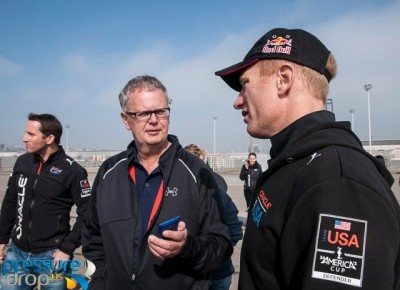
 Oracle Team USA have been racking up the training days since they relaunched their repaired AC72 less than two weeks ago in San Francisco. Sail Racing Magazine editor Justin Chisholm caught up with skipper James Spithill for an update on their progress.
SRM: You must be relieved to put last year’s crash behind you and get back out on the water again. Do you think the experience of having to deal with the crash has been beneficial in any way to the team?
James Spithill: Absolutely. I think no other team has been pushed as hard as we have. From a labour perspective, to get this boat back in action this has been our biggest challenge to date.
To go through all that and get back on the water with a better boat than we had before is pretty impressive. It’s been a huge test and I don’t think anyone has been pushed as hard as we have been pushed over the winter as a team.
Some times when the pressure comes on and a team has to face some real adversity, it can just implode. But for us, it has been a good sign of strength and the real positive is that we have been able to see how our people reacted and what we saw was pretty encouraging.
SRM: Was the training days penalty from the espionage episode a big setback?
James Spithill: Not at all. It’s all part of the games of the Cup, you know. Some teams like to play those games in the protest room and we prefer to get the results on the water.
SRM: This week you have been out doing windward leeward courses on San Francisco Bay. Were you replicating the courses you will race in the Cup?
James Spithill: Not really in that we have been sailing longer courses. The Cup course will be around three mile legs and we were sailing more like four or five mile legs.
SRM: When we saw you you were not foiling downwind?
James Spithill: We were trying a few different things. We were actually foiling most of the time that day. There we just a few times when we went into what we call displacement mode.
It really depends on the conditions. Something we are trying to learn now is the times to foil and the times not too.
SRM: What did you learn from the line ups you have had with Artemis recently?
James Spithill: The list is so long. I think both teams learned a huge amount. You have all your prediction software and stuff but until you line up against another boat, that’s when you can see certain areas where you are strong and certain areas where you are weak.
It was really important for both teams because both crew are forced to go out there and make it happen for real
SRM: You made a number of modifications to the boat during the repair process, what are your thoughts on how much the boat has improved?
James Spithill: It’s a new boat, it really is. The effort that the boat builders and the engineers have put in – they now get to see that in action on the water.
It’s pretty impressive, this is our third day sailing in a row which is a big ask on a boat like this. To sail a boat like this four days a week is a lot and especially so when you are pushing it like we are out on the water.
SRM: How hard do you have to push?
James Spithill: It’s like driving a race car. In these boats you need to be close to the edge so you are red lining – and if you are not then you are slower. Yes, you really have to push these boats to get the most out of them.
SRM: The crash happened on a bear away. Is the boat safer in that department now?
James Spithill: The boat is definitely improved but the risks are always there. These boats are incredibly powered up and just like a NASCAR or Formula 1 car you can easily slide off and hit the wall.
You have got that accelerator and a lot of horsepower and it is about managing that. We are obviously trying not to cross that line.
SRM: What improvements have you made around safety in the aftermath of the crash?
James Spithill: We are fully prepared now in terms of the gear we are wearing, we are carrying spare air, knives. We had a group of ex-Navy guys come in to train us, guys who were involved in Navy Seal training, ex-navy divers – all guys who had been through some hard stuff.
That was fantastic because those guys are so methodical about being prepared if something goes down. We really went over the top on all of that so we believe we are fully prepared now and so it gives everyone confidence that if we go over again we will hopefully be in good shape.
SRM: Looking at the new wheel set up on the boat, it looks pretty cramped at the helmsman’s station with the particularly with the angled wheel. How has that been to sail with?
James Spithill: It just works. I have a grinder just behind me and we can just fit in there so it seems fine. The angle of the wheel? Well to be honest, you can put the wheel at any angle and it you very quickly get used to it.
SRM: When and how will you make a decision on who will drive the boat for the Cup?
James Spithill: We will make a decision, not just on the driver but on the whole 11 man crew as we get closer to the Cup.
We still want to try a lot of different things and we are still learning really how to sail this boat and what it requires. We have gone out and hired the best sailors on purpose so that we all can push each other. But that also means that we have the opportunity to have backups.
You are allowed to rotate two sailors, on a race day and we wanted to have some depth – and we think we have got that. From a team point of view and from my point of view as skipper its pretty nice to be in that position.
SRM: Is the plan to have two boats and race against each other?
James Spithill: We are going to see how that goes but we are setting up that way for sure. It’s a real risk management sort of situation but that’s why we have hired the best sailors so we can have the depth to do that.
We just don’t get the luxury of getting to race in the challenger series. So we have to be set up to be ready to go and push each other.
SRM: When might we see the second boat?
James Spithill: Later on towards the summer. But the other option is that we can push each other in the 45s. That’s why the world series has been great because that is one design and so it comes down to the sailors’ ability.
SRM: How would you describe the difference between sailing the 45s and the 72s?
James Spithill: Just the power. Well actually, the power and the risk. If you capsize the 45 you can get away with it but capsize the 72 and it is a big deal.
The 72s are a completely new concept for our sport. In the past there was never any risk, other than maybe dropping a sail in the water or maybe breaking a mast, but you just weren’t going that fast to tip them over. Now that is a real reality.
If you ask, why does Jimmy Johnson or Michael Schumacher crash, the answer is that they are trying to get the most out of their vehicles. And that is because they are rewarded for it in terms of performance.
But it is also a balance as you are not going to win the race if you crash the boat. The other issue is that it takes us a lot longer to rebuild than the race car teams. A lot of these components are highly labour intensive – its not like we can just go and weld up another chassis.
But that is the new game and I think it is better that way because it will show the good guys and I think it will attract more of a mainstream audience when they can see there is some risk involved.
Image credit: Phinneas J Photoboy/Pressure Drop
The post 34th America’s Cup – James Spithill updates us on Oracle Team USA’s comeback appeared first on Sail Racing Magazine.