 Since re-launching their repaired and reconfigured AC72 catamaran at the beginning of February, Oracle Team USA have been going all out on their training schedule in San Francisco, in their quest to win the 34th America’s Cup.
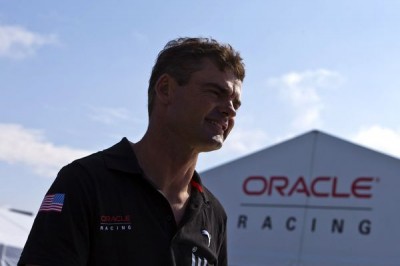
Sail Racing Magazine editor Justin Chisholm sat down with Darren Bundock – a multiple multihull world champion, double Olympic Tornado class medallist and a key member of the OTUSA coaching team – to get an update on their progress, find out what goes into honing an 11-man AC72 crew, and highlight some of the differences from the AC monohull crews of old.
SRM: What are the main priorities of the OTUSA coaching team right now?
Darren Bundock: The primary coach is Philippe Presti. I am there helping him and primarily looking at the boat handling aspect.
We put a lot of focus on crew manoeuvres and how everyone moves across the boat, making sure everyone is efficient. We use video to help us with that, so we always have at least two Go-Pro’s going on the boat at any one time.
We study timings, when people are crossing the boat and how to make that the most efficient when people are running back and forth. It’s about making sure everyone is in rhythm – if someone is running from one end of the boat to the other we are trying to make sure it is from one job to the next and they are not tripping over one another.
SRM: It sounds like a time and motion study?
Darren Bundock: It is, actually. It’s sort of choreographing how the crew work all fits together.
SRM: To put that choreography in context, can you help us understand the length of time it takes to tack or gybe the boat from starting to finishing?
Darren Bundock: It’s getting quick. I guess we are looking at about 20 seconds.
The focus recently has been on the manoeuvres and getting that all in sync. So that means lots of tacks and gybes and looking at the video. The footage is just golden – you can see everything that happens. Then you can put a timing on it and see where people go and see when they get to where they are supposed to be. If they get there early and they are standing around waiting then they can leave later.
SRM: So you are looking to be shaving seconds off the times for the tacks and gybes?
Darren Bundock: Absolutely. With multihulls, you always want to keep as much weight on the rail as possible for leverage, so keeping the guys on the right side of the boat for as long as possible is important.
So if we can see they leave at 15 seconds and get to the other side and then stand there for three seconds before they need to start grinding, then next time they are going to leave on 12 seconds.
SRM: The individual crew roles are very different on the AC72s from the old AC monohulls. Can you break down what the 11 crew are each responsible for?
Darren Bundock: Well there are 11 guys on board and basically 10 of them are grinders.
Everyone is grinding, the boat is so physical and because everything is happening so fast as well, everyone just clicks in and grinds it in. Nobody is really just dedicated to one role. All the grinders can switch into everyone’s winch so they can switch back and forth. So for a hoist or something they can all just click in and grind.
You have got one trimmer but he is still grinding in the gybes as well. The two guys at the front are responsible for grinding for the jib or the gennaker, but usually it is four guys at least to grind it in. For example, the wing trimmer, he grinds during the gybe for the gennaker too.
The next ones back are grinding the hydraulics for the boards – grinding the boards up and down and back and forth is all hydraulics and that needs grinding power to fuel it.
That’s the biggest difference between the AC72s and the old AC monohulls – you on every tack or gybe you spend a lot of effort getting the boards up and down. You basically have two sets of guys on a tack or gybe, one set on one side grinding a board up and another set on the other side grinding their board down.
On our boat there are two guys behind the helmsman. One is a tactician but they are both grinding – one is a dedicated grinder but the tactician is also grinding as well. Their main function is controlling the wing.
Then you have got the helmsman and he is the only one who is not grinding, but he is multitasking at times and as he has to hold the wing sheet for the bear aways and some of the downwind.
SRM: Looking specifically at the wing trimmer, how does one person control that complex aerofoil?
Darren Bundock: Well in basic terms, he is holding a rope just like any other trimmer would. But then he has a set of button that control the shape of the wing – the camber and twist. But the difference is that those buttons trigger the hydraulics and the hydraulics are powered by somebody grinding. Every time he presses a button it spends some of the hydraulic pressure and that has to be topped up by somebody grinding.

SRM: Do you have any idea on how many calories the crew are burring during a four or five hour training session?
Darren Bundock: I don’t, but the gym instructors do for sure – and they are the one’s who pack the daily bags with the snacks and lunches. If we can leave after lunch then we always have a hot lunch at the base, otherwise sandwiches or burritos or whatever it is are packed for the day.
You just can’t eat or drink enough during the day. That’s why every time the boat stops you will see that the food bags go on and the guys or always drinking or eating.
A longer version of this interview will appear in the March issue of Sail Racing Magazine.
The post 34th America’s Cup – Oracle’s Darren Bundock on coaching, calories and crew choreography. appeared first on Sail Racing Magazine.