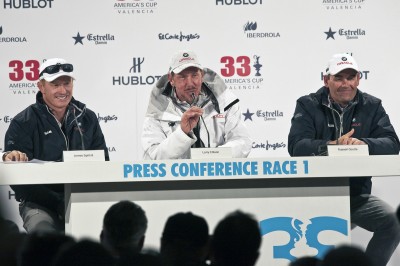

A year from now, minus a handful of days, Jimmy Spithill or Ben Ainslie will take to the waters of San Francisco, at the helm of Oracle Team USA’s AC72, ready to race for the first time, most probably, against Dean Barker and the Emirates Team New Zealand crew and begin the defense of the America’s Cup. Two and a half years after their emphatic victory in Valencia, the American team bankrolled by Larry Ellison will try to make sure that the America’s Cup doesn’t leave the trophy room of the Golden Gate Yacht Club to fly across the Pacific and the New Zealand Yacht Squadron.
Unlike any other sports competition in the world, the America’s Cup has a distinct peculiarity, where the winner has the liberty to set the rules but if you are reader of this website we certainly don’t have to remind you of all that. The 34th America’s Cup came on the heels of a controversial 33rd edition that saw a nearly 3-year long legal fight in the New York Supreme Court. Upon winning in Valencia, back in February 2010, Larry Ellison talked to ABC’s local affiliate in San Francisco, giving the general framework of what the future edition would look like and what we should be expecting from the new holders of the world’s oldest sports trophy.
Given the milestone that we have reached, one year to the first race, it is interesting to go back and compare what Ellison promised two and a half years and how reality turned out.
Note: If the video doesn’t display correctly, please click here to watch it.
Ellison starts his interview by stating that “it’s going to be a more international event that it’s ever been before.” Unfortunately for the billionaire software mogul, the 2013 Louis Vuitton Cup will be the one with the smallest number of participating teams ever, just four, in the 30-year history of the event. Ellison states that organizers would need enough room to build “a Swedish base, a British base, a couple of French bases, three Italian bases, the South Africans, American teams. Hopefully there will be multiple American teams challenging us in a Defender Series before the America’s Cup as well as the Louis Vuitton Cup for all of the foreign teams competing to race in the America’s Cup. Maybe 16 teams.”
Out of the four challengers (Emirates Team New Zealand, Artemis Racing, Luna Rossa and Team Korea) only the first three have launched or are about to launch their AC72 yacht and have the necessary funding to go ahead. Team korea is still a mystery and there has been no news whatsoever from the Asian challenger in regards to their financial situation and the status of their AC72 yacht. Kim Dong-Young, Team Principal, and Brett Bakewell-White, Design and Technical Director, did not reply to our emails asking for an update. Therefore, organizers face the plausible risk of having just three challengers next year. At least all of them are guaranteed a spot in the semi-finals.
According to Wikipedia, Ellison is the third wealthiest American citizen, with an estimated worth of $36.5 billion. He’s a self-made billionaire and an extremely astute and shrewd businessman. As a result, it is very difficult to understand how he could be so much off target. For sure he must have been aware, even in early 2010, of the dear financial situation globally in general and in Europe in particular. Where did the Golden Gate Yacht Club and the America’s Cup Event Authority fail? Was the vision delusional or was its execution a failure?
What is even more puzzling is Ellison assurance that “we’re not going to go back to these multihulls like we raced in Valencia, where our boat is 23 stories tall. We have this enormously complex wing driving our boat. That’s a VERY expensive piece of technology. Very expensive to engineer, very expensive to build, very risky to sail. So, we might go to 60 footers with soft sails, still very, very fast but with a campaign that can go back to two, three, four million dollars.”
Both Oracle Team USA, the Defender, and Artemis Racing, the Challenger of Record, have first-hand experience of the complexity and risks of wing technology. They both suffered significant breakage at the very early stages of their AC72 testing, Oracle Team USA a mere two hours into the very first day of sailing, that have caused setbacks in their campaigns, going from several weeks to several months! As for the price of the AC72 yachts, even if there isn’t any official figure, it is reckoned they carry a tag of approximately 10 million euros, a far cry from the four million dollars Ellison was claiming an ENTIRE campaign would cost! A shrewd businessman he is, he must know that when a simple TP52 costs close to two million dollars it’s impossible to run a three-year, or even two-year campaign, with just four million.
Therefore it’s indeed puzzling how Ellison states one thing and then goes on carrying out the exact opposite. Not only didn’t we see the South Africans or the Swedes coming back, this will be the first time in a long time that a French challenger will not give it a shot, regardless of the fact they are often mismanaged failures. As to making the sport “commercially attractive” it was proven that with the exception of Emirates Team New Zealand, America’s Cup teams need a very wealthy owner to survive or a company owned by a multi-millionaire. Even Team New Zealand was able to survive thanks to the generosity of Matteo de Nora and the New Zealand government.
I would agree that the move to catamarans hasn’t been as negative as it was originally expected, at least with the A45 circuit. Racing is indeed close and exciting, it can take place a few hundred meters from spectators and weather conditions have to be really adverse in order to cancel racing. Racing management is independent and the Defender will not race in the challenger selection series. After criticizing Alinghi for three years it would have been unthinkable for Ellison’s team to repeat the shenanigans Bertarelli tried to do with his idiotic bed-partners from the CNEV.
However, the America’s Cup Event Authority, the commercial part of the organization, is headed by the former COO of the Defender. While there might be no doubt whatsoever regarding the independence of the race committee or the umpires, there are more subtle ways to control the event. Take for example two of the most prominent and well-known partners of the America’s Cup, Puma and Red Bull. Both companies are also Oracle Team USA’s partners and in their official communication and marketing the two identities are intertwined.
The question, of course, is whether all that matters. The Defender will always own the America’s Cup and anyone would be simply naive to think that if you are given the chance to set the rules of a game you would just give this prerogative away. That’s the reason it has survived so many years. The real challenge is to try and win even if you know that the current holder will stack the cards in its favor, regardless of the rhetoric or PR.