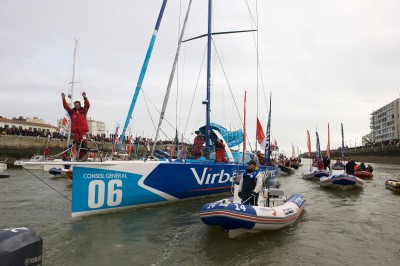

[Source: Vendée Globe] The Vendée Globe welcome afforded to fourth placed Jean-Pierre Dick by a huge and passionate crowd was one worthy of a race winner. Having sailed more than 2500 miles with no keel, having lead the race – his third participation – and having been among the top three for most of the course, all clearly inspired a big, partisan crowd to take to the channel into the heart of Les Sables d’Olonne this afternoon to welcome ‘ JP’. The skipper who is originally from Nice and only really took to the IMOCA class ten years ago left Les Sables d’Olonne 88 days ago as one of the favourites and returned one of the outstanding heroes. Dick took disappointments in his stride but they took their toll on his overall performance.
First, he recalled, he lost a key small gennaker in the water – one which would have been his reaching workhorse in the South which forced him to re-think his strategy at times. Then he struggled with a jammed halyard hook which left him unable to set the optimum headsail for some time. He eventually climbed the mast of Virbac-Paprec 3 several times to free it but lost more miles. His problems were capped when he lost his keel on the evening of 21st Janaury.
And so his fourth place reflects the incredible tenacity of JP Dick. He concluded with a Chinese proverb:
“The goal is not in the goal but in the pathway.”
Jean-Pierre Dick on the podium:
On stopping in Galicia
“ It was very difficult in the north of Spain to try and get some rest. I had to try and make the most of that time to get the rest because it had been so stressful around Cape Finisterre with big waves because there was a good chance of the boat capsizing then. I managed to get the sail reduced, but yes it was really tough. I was really pleased to stop there and get some rest.”
LES SABLES D’OLONNE (FRA) – 04/02/13 – PHOTO JEAN MARIE LIOT / DPPI – VENDEE GLOBE FINISH FOR JEAN PIERRE DICK (FRA) / VIRBAC PAPREC 3
On the welcome back, mooring in Spain and sailing with no keel
“The welcome here has been extraordinary. That transition between being alone and arriving here makes me so proud to be here. The main feeling I have is pride, I am so proud just now of getting my boat back here across the finish line. It was not easy and I was not sure I would finish and so that is important too. And also finishing in a good position, that is important too. You have to really want to do it. And really dig deep into yourself to bring the boat home. I really tried to work the depression but it was not easy without a keel. It is this race which lets you do that and it is this public which appreciates it, it is just magical. So you can just about make it without a keel but only if you are super safe with reduced sail and then you can rest a bit, but as soon as you get more than 20% a heel then you have to be careful, you can heel too much and so you have to keep a small headsail area and the mainsail reefed right down to what you need. We like going fast as a racer, you want to go fast. So obviously when the wind gets up you want to go faster. And so you have to change your thinking. Three days on the mooring and you are rested and then you have to remember to go along slowly.”
On safety and security changes since the last Vendée Globe and the most stress, at Cape Finisterre
“Looking at the IMOCA today we did a lot of preparation inside the boat and with Jean Le Cam’s experience, I have changed a lot of the inside so I can close a lot of the compartments to make it more secure. You have a survival suit, and iridium phone, and there are a lot of advances in security, and so you know that you grab the right things. That luxury was not available to people in the past. Things have really moved on and that is good. You can have special alarms and can speak on the VHF over long distances which makes you feel more secure. Cape Finisterre really was tough, a bit cross swell, fishing boats which don’t show up on the AIS, the automatic positioning system, but you cant sleep. There are boats all around you, there are cargo ships all around. At one point I crossed a bit cargo and they go straight on. They don’t see you and they go straight on. I saw him on the AIS. I had three or four minutes to change course, but it was close. I should have been ahead but chose not to.”
Advice on sailing with no keel and going on
“Marc Guillemot and Roland Jourdain gave me advice, as much as I could gather which would be useful. Marc and I had a long chat, and he said it really you who makes the decision. I tried sailing like that but he said you are the one who makes the decision and it worked out in the end. The tough question was whether to carry on to Les Sables d’Olonne or to stop. That was a difficult and tough decision to take. There are dangers in stopping too, so going in to the right place, finding a mooring at the right time without too much tide and wind.”
On mooring and using the engine
“It is strange to come in at night. Thankfully there was not too much wind to do the manoeuvres but I had to use the engine for one or two minutes because I was getting too close to the wall. You could not let go on the mooring for a minute. There was 35-40kts on the mooring and I went and swam around to put some extra rope around the mooring and so now here I am.”
Looking at his race, the good and the bad
“ I must say I was not expecting a Vendée Globe like this. I was really well prepared but the toughest things I had were when the loop on one of my sails broke in the south and I can remember at the time I was trying to get some rest and I was looking up through the hatchway to see that the sail was alright and suddenly there was nothing there. The sail had fallen into the water and gone under the boat and got stuck. That was just when I had moved into the lead. I had taken a good option and with that sail in the water it was my key sail. My small gennaker which I would rely on in the 25-30kts of wind in the south, I lost it and so I had to rethink how I would use the other sails. So psychologically that was hard, realising that I would really have to fight to win and it was not really going to be possible. I did my best but did lose a few miles, maybe fifty or sixty miles where I just did not have much luck. I then got stuck in an anticyclone and Francois and Armel managed to get ahead about 500 miles and I just could never get back. I made to 250 miles, bit by bit, but then I had a few other technical issues. I had to go up the mast two or three times to fix a hook which was stuck. There was a really big swell in the south and going up the mast there I went up a few times and it is impressive and managed to fix it in the end without losing too much ground and then I had the problem with the forestay when the strop.”