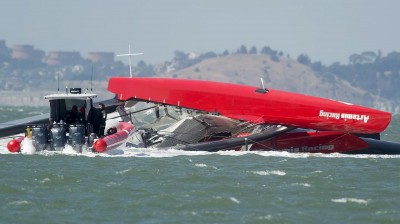
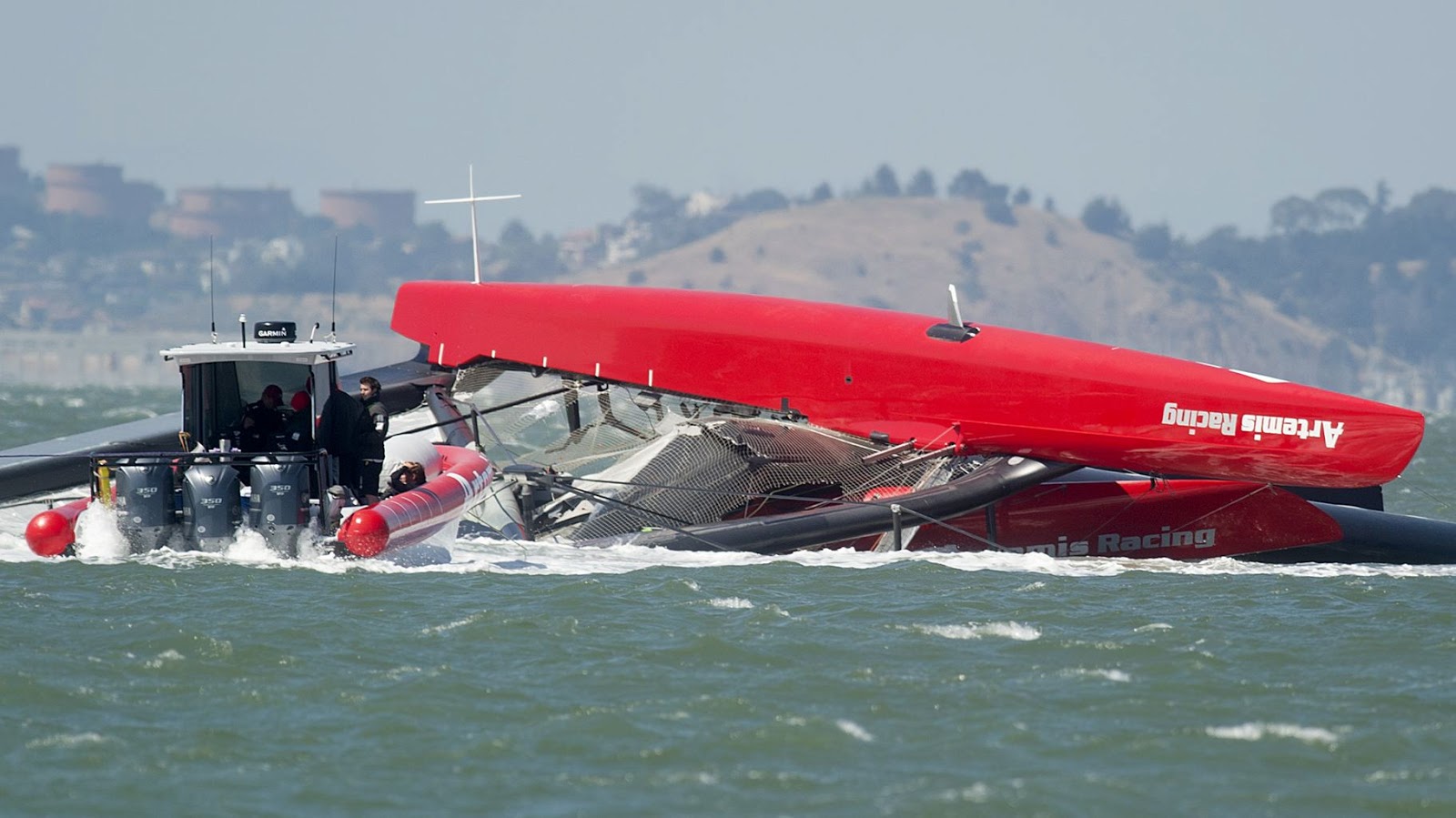
How can an America’s Cup team funded by one of the world’s most important energy traders, Torbjörn Törnqvist, managed by an acclaimed sailor, Paul Cayard, and with one of the world’s most recognized and successful designers, Juan Kouyoumdjian, go so wrong in the design of its AC72 yacht?
With a brand new America’s Cup class and a boat that has never been designed and built before, it is understandable that someone could direct themselves to the wrong corner of the design box and get stuck there while their competitors might go the opposite way and find a much better solution. Add to this the extremely tight schedule, less than two years from rule publication to launch, and the complexity of the AC72 catamarans and the possibilities of going down the wrong design path increase considerably.
In this website we have been staunch supporters of Juan Kouyoumdjian who, let us never forget it, has had three commanding victories in the Volvo Ocean Race. We have also criticized Knut Frostad and the entire VOR organization for not choosing Kouyoumdjian for the design of the new VO65 one-design yacht. A couple of times we have even called him a design genius. This is where our two informants, with direct knowledge of what took place inside Artemis Racing started to differ from our point of view.
First of all, they claim, there are no “geniuses” in modern yacht design. It’s more a question of brute force technology and open-mindedness, both, they claim, absent from the design team. They claim that an important factor is a very good VPP. Juan has one for monohulls, that has successfully proven itself over the years, but his brother Gonzalo had been trying, unsuccessfully, for years to develop one for multihulls and what he had for Artemis was a “joke”. It turned out “weird” numbers and Gonzalo Kouyoumdjian would be nervous to show any number at meetings with the Artemis team.
In addition, he never asked for help or input from the sailors or to test a flying board just to see the results, always according to our sources. That last point, stems from the conviction both “Captain” Cayard, as our source calls him, and Juan Kouyoumdjian had that “this Cup won’t be won by a flying boat”. From the very beginning, Artemis chose that path.
Key personnel was also either left out of the process or fired. Allegedly, Tom Schnackenberg was pushed into the performance team, despite the wealth of experience accumulated in 12 AC campaigns since 1977! According to one of our sources, Juan liked Tom’s ideas but that just was it. Another “big mistake”, as our sources claim, they made early on was firing Jared Henderson, team manager for a number of years.
Artemis Racing had a head start over the other two challengers, Emirates Team NZ and Luna Rossa, as they started working on the design in the fall of 2010! They officially announced their challenge in November of that year and in May 2011 they brought to Valencia the former Gitana Orma 60 trimaran. They modified it by extending the length of the outer hulls to 72 feet and sailed her for the first time in October 2011.
While construction of the first AC72 started in December 2011, the first wing was well underway and was fitted on the modified trimaran in March 2012. The first of a chain of mishaps took place just two months later when in May 2012, the wing collapsed on the platform while sailing off Valencia with 13 knots of wind and calm seas.
Our sources paint a bleak picture of what led to that incident. First of all, they “kept changing the design brief”. Then they had to throw away one moulding since they had “huge problems”. That cost the team “a lot” of money and finally builders weren’t experienced with TPT, as our sources claim. AB-Structures, the company set up by Andrea Avaldi and Fabio Bressan, had a lot to do themselves before Hervé Devaux came into the team.
We might never know the true causes of the wing collapse in Valencia but if our sources are correct, faulty engineering or construction can’t be ruled out. Cayard gathered the team in Valencia after the collapse of the wing and gave a speech “about how when he won the Volvo they broke on day one, blah, blah, blah…” The feeling within the team was, according to the same sources, that although Cayard might be an excellent sailor, he wasn’t a team leader. It could also be the reason why, according to the same sources, most people’s drive within the team died “a long time ago”. Cayard is “very hard to talk to”, and for sure isn’t a “listener”, according to our two sources.
Given the ongoing SF police and coroner’s investigation on the tragic and fatal accident of May 9th, that led to the unfortunate death of Andrew Simpson, I decided to shorten this editorial and refrain from writing anything on the issue, despite the information we were given. Although both our sources are extremely reliable and have direct knowledge of the issues, we will not take any legal risks. Had it been a simple crash or collision it would have been completely different.
The second AC72 boat is currently under assembly but then again, our sources would be very surprised if she is safely or stable foiling, since practically no hydro CFD on foiling boards was done. It would have taken them months to get reliable simulations running, let alone foiling simulations. She is after all a sistership, albeit modified, of the boat that capsized. Both our sources are sure Artemis Racing can be on the starting line, more or less a month from now, but absolutely with no hope of winning a race, unless the other team has a breakage.
On hindsight, our sources agree that the best thing Artemis could have done was to “let Adam May loose” a year ago when they saw the other three teams flying and trial at full / AC45 scale. Unfortunately, it is too late now.
I feel our sources aren’t so far away from the truth, given Paul Cayard’s recent comments in the San Francisco Chronicle, where he blames America’s Cup organizers for choosing a dangerous boat (!!!!!!). How can the CEO of an America’s Cup challenger claim that they’ve “got a boat that’s made for San Diego (where the winds are much lighter), and we’re trying to race it in San Francisco” is beyond our understanding. Even if he might be true about the potential danger of the AC72′s in San Francisco, this is a talk he should have made two-three years ago, certainly not a week before the opening ceremony of the Louis Vuitton Cup!

Smiling faces at the presentation of the World Sailing League. From left, Russell Coutts, João Lagos and Paul Cayard. Lisbon, 9 February 2007